Developmental Services Worker
The Developmental Services Worker program focuses on providing practical and meaningful services and support with individuals of all ages who have intellectual, physical and learning disabilities with a focus on human rights social justice, community inclusion and health.
Program Information
Start Date
September 07, 2027
Domestic Availability
Accepting Applications
International Availability
Coming Soon
CIP Code
19.0710
Program Code
DSW
Delivery
Hybrid, In Person
Credential
Ontario College Diploma
Academic School
Location
Program Contact
Domestic Tuition
per semester*
International Tuition
per semester*
*Domestic tuition amounts shown are from the 2026-2027 academic year and are subject to change.
*International tuition amounts shown are from the 2026-2027 academic year and are subject to change.
Apply Now
Canadian StudentsView Curriculum
September 07, 2027
Domestic Availability
Accepting Applications
International Availability
Coming Soon
CIP Code
19.0710
Program Code
SLDSW
Delivery
Hybrid, In Person
Credential
Ontario College Diploma
Academic School
Location
Program Contact
Tuition information is unavailable at this time
Apply Now
Canadian StudentsView Curriculum
Gradates of the Developmental Services Worker program have the specialized knowledge, skills, competencies and attitudes to support the rights and empowerment of people with disabilities and their family. They demonstrate leadership in promoting social inclusion and helping people live their best lives. Graduates provide support and services to children, youth, and adults with various intellectual disabilities, such as autism, neurocognitive disorders, down syndrome, fetal alcohol spectrum disorder, acquired brain injury, physical disabilities or learning disabilities.
These four semesters (two years) give students the knowledge and skills required for professionals who make a difference every day in the lives of children, youth and adults who have disabilities, and their support network, at home and in their communities. This includes specific skills to support people with disabilities in schools, recreation, mental health and addictions, the justice system, employment support and other places in our communities. Students also have the option to focus more on First nations, Inuit and Metis peoples through the Indigenous Perspectives Designation. Curriculum and field placements align with provincial and industry standards for the developmental services sector and is:
- Focused on person-centered, strength-based assessments and develop strategies for individuals, their families, and community inclusion.
- Grounded in professional competencies, ethics and values such as social justice, empowerment, dignity, self-worth, the importance of healthy human relationships, and integrity.
- Dynamic with hands-on and applied learning labs, simulation, and community-based projects.
- Connected to organizations that hire graduates with 685 hours in field placements beginning in semester 3
- Responsible through sustainability outcomes
Are you working in an organization that supports people with developmental disabilities and have related education (Personal Support Worker, Educational Support, Social Service Worker, etc.)? Contact us for more information about how your education and experience may reduce the time it takes to complete the Developmental Services Worker diploma. You can also use our “Fast Pass” to see if you qualify for course credits through Prior Learning Assessment and Recognition.
- Small class sizes and individual attention enhance your learning experience
- Applied learning projects in partnership with local agencies allows for hands-on skill building in developmental services, contribution to the community and professional networking
- In-depth training, academic and work placement experience necessary to be successful in this rewarding field
- You will be supported by our knowledgeable and caring faculty who are experts in the developmental service field
- See what DSW students are up to by following us on Facebook
- Learn basic food safety and food preparation skills to prepare you for teaching life skills and supporting the wellbeing of people you work with.
An essential component of your education will include experiential learning through course work as well as field placements. Three supervised field placements provide students with varied practical and networking experience where many students receive job offers. Students also have the option of international placements in their fourth semester; however, this should be discussed with the program coordinator as early as possible (and prior to the end of semester 2) in order to assist in facilitating it.
Career Opportunities providing supports and services to those with intellectual or physical disabilities is highly rewarding work. There is a shortage of skilled and qualified workers to meet the demand in the developmental services and disability sectors, as well as related employment.
For greater employability options, a Class G Drivers license prior to graduation is highly recommended. Graduates will have the required expertise to work with people of all ages in a variety of diverse settings in Ontario, across Canada or abroad, including:
- Mental health/Dual Diagnosis
- Self-employment through individualized funding
- Facilitating Person-Directed Planning
- Educational Support in primary, secondary and post-secondary schools
- Employment supports
- Community inclusion initiatives and teaching life skills
- Home based supports.
- Behavioural supports
- Various camps
Program graduates can be employed in a variety of locations, including:
- Access Community Services
- Alternatives Community Program Services
- Array Services
- Brain Injury Association Peterborough Region
- Canadian Mental Health Association (Dual Diagnosis)
- Christian Horizons
- Community Living Campbellford-Brighton
- Community Living Durham North
- Community Living Trent Highlands
- Community Living West Northumberland
- DeafBlind Ontario
- Down Syndrome Association of Peterborough
- Kawartha Pine Ridge District School Board
- Kerry's Place
- Ontario Developmental Services
- Peterborough Victoria Northumberland and Clarington Catholic District School Board
- Stewart Homes
- Canopy Support Services
- for private families/self-employment as independent facilitators/support workers
These qualities are helpful for a Developmental Service Worker:
- Change maker
- Emotional Maturity
- Empathy
- Self-Awareness
- Passionate About Human Rights and inclusion
- Creative
- Problem Solver
Do You Want To:
- Make a difference every day?
- Have variety in the work I can do and opportunities for new roles/ advancement?
- Have a rewarding job but be challenged at the same time?
- Find part-time work in my chosen career by second semester?
- Help people live their best lives?
- Have fun in your job?
Prospective students with special needs or limitations that may affect their field placement or potential employment opportunities are encouraged to discuss their program and career goals with a program coordinator prior to admissions.
Immunization Requirements
Your program has mandatory immunization requirements that include a "pre-entry" deadline date for submission. For more information, and to print a copy of the immunization form, please see the Immunization Information page.
Non Academic Requirements
Your program has mandatory requirements which may include a criminal reference check, first aid, CPR-C, etc. For more information, please see the Non Academic Requirements page.
- Conduct oneself in a professional and ethical manner to enhance service delivery and respect for others.
- Provide person-directed supports to people with developmental disabilities to foster their independence, decision-making abilities, inclusion in the community, and overall fulfilment.
- Comply with current legislation, standards, regulations, policies, practices, and procedures to help create safe environments and mitigate risk.
- Support the health and well-being of people with developmental disabilities including those with dual diagnosis and complex needs to promote a meaningful life experience across the lifespan.
- Use and adapt a variety of evidence-based teaching and learning strategies that support the individual?s growth and potential.
- Advocate and collaborate with interdisciplinary professionals, community partners and service users to address systemic barriers and develop inclusive communities that respect the culture, values, beliefs and language of people with developmental disabilities.
- Plan strategies for ongoing personal and professional development to improve job performance, sustainability, and holistic self-care.
- Use workplace technology and assistive devices to boost productivity, improve communication, and promote the independence of people with developmental disabilities.
Students applying to Developmental Services Worker must meet the following requirements:
- OSSD including Gr 12 C English
Recommended (but not required for admission)
- Note that students are encouraged to use their time during their diploma to obtain their G driver’s license. Employers are often looking for students who have or are close to obtaining their license and it is an asset for employment.
PC / Windows
- Operating System:Windows 10
- Processor:Core i5 - 1.6Ghz minimum
- Memory:8GB minimum
- Hard Disk:160GB minimum
Apple / MacOS
- Operating System:MacOS 10.12 or newer
- Processor:Core i5 6th Gen or better
- Memory:8GB minimum
- Hard Disk:160GB minimum
Internet Connection: 2.5 Mbps Download and 3.0 Mbps Upload (minimum)
Transfer Agreements
You may be able to use credits obtained at Fleming College to continue your postsecondary education in pursuit of a degree. The articulation and credit transfer agreements with our partner institutions are summarized here.
Bachelor of Child, Youth and Family Practice (3YR)
Requirement
- Minimum 65% cumulative program average.
- The program is offered face-to-face (Logan campus).
Transfer Credit
- 120 credit points out of a 240 credit point degree.
- Review the articulation agreement for further details.
To apply please see the Griffith University's admissions website.
For more information
Visit the Griffith University website for further articulation and program information.
See the official articulation agreement.
Bachelor of Human Services (3Yr)
Requirement
- Minimum 65% cumulative program average.
- The program is offered face-to-face (Gold Coast campus or Logan campus) or online.
Transfer Credit
- 120 credit points out of a 240-credit point degree.
- Refer to the articulation agreement for further details.
To apply please see the Griffith University's admissions website.
For more information
Visit the Griffith University website for further articulation and program information.
See the official articulation agreement.
Bachelor of Child and Youth Care
Requirement
- Minimum 65% cumulative program average.
- Possess ENG4U (Grade 12 University English) or equivalent with a course grade of 65%.
Transfer Credit
- 45 out of a 120-credit degree.
- Refer to ONTransfer.ca for further details.
To apply please see the Ontario Colleges website.
For more information
Visit the Humber Polytechnic website for further articulation and program information.
Visit the ONTransfer.ca website for agreement information.
Bachelor of Social Work
Requirement
- Minimum 70% cumulative program average.
- Minimum 70% (or 'P') in field placements.
Transfer Credit
- 5 out of a 20-credit degree.
- Refer to ONTransfer.ca for further details.
To apply please see the Ontario Universities' Application Centre (OUAC) website.
For more information
Visit the Lakehead University website for further articulation and program information.
Visit the ONTransfer.ca website for agreement information.
Bachelor of Arts (General) in Gerontology
Requirement
- Minimum 80% cumulative program average.
Transfer Credit
- 42 out of a 90-credit degree.
- Refer to ONTransfer.ca for further details.
To apply please see the Ontario Universities' Application Centre (OUAC) website.
For more information
Visit the Laurentian University website for further articulation and program information.
Visit the ONTransfer.ca website for agreement information.
Bachelor of Social Work in Indigenous Social Work
Requirement
- Minimum 70% cumulative program average.
Transfer Credit
- 42 out of a 120-credit degree.
- Refer to ONTransfer.ca for further details.
To apply please see the Ontario Universities' Application Centre (OUAC) website.
For more information
Visit the Laurentian University website for further articulation and program information.
Visit the ONTransfer.ca website for agreement information.
Bachelor of Arts in Sociology
Requirement
- Minimum 70% cumulative program average.
Transfer Credit
- 45 out of a 120-credit degree.
- Refer to ONTransfer.ca for further details.
To apply please see the Ontario Universities' Application Centre (OUAC) website.
For more information
Visit the Nipissing University website for further articulation and program information.
Visit the ONTransfer.ca website for agreement information.
Bachelor of Social Work
Requirement
- Minimum 70% cumulative program average.
- Students must apply for admission consideration to the professional years (Years 3 & 4) of the program. Admission to the first or second year of the Bachelor of Social Work program does not guarantee acceptance into the professional years.
Transfer Credit
- 30 out of a 120-credit degree.
- Refer to ONTransfer.ca for further details.
To apply please see the Ontario Universities' Application Centre (OUAC) website.
For more information
Visit the Nipissing University website for further articulation and program information.
Visit the ONTransfer.ca website for agreement information.
Bachelor of Arts - General
Requirement
- Minimum mid-70% cumulative program average.
Transfer Credit
- 60 out of a 120-credit degree.
- Refer to OntarioTech's website for further details.
To apply please see the Ontario Universities' Application Centre (OUAC) website.
For more information
Visit the Ontario Tech University website for further articulation and program information.
Bachelor of Arts in Educational Psychology
Requirement
- Minimum mid-70% cumulative program average.
Transfer Credit
- 60 out of a 120-credit degree.
- Refer to OntarioTech's website for further details.
To apply please see the Ontario Universities' Application Centre (OUAC) website.
For more information
Visit the Ontario Tech University website for further articulation and program information.
Bachelor of Arts in Educational Studies and Digital Technology
Requirement
- Minimum mid-70% cumulative program average.
Transfer Credit
- 60 out of a 120-credit degree.
- Refer to ONTransfer.ca for further details.
To apply please see the Ontario Universities' Application Centre (OUAC) website.
For more information
Visit the Ontario Tech University website for further articulation and program information.
Bachelor of Arts in Political Science
Requirement
- Minimum mid-70% cumulative program average.
Transfer Credit
- 60 out of a 120-credit degree.
- Refer to ONTransfer.ca for further details.
To apply please see the Ontario Universities' Application Centre (OUAC) website.
For more information
Visit the Ontario Tech University website for further articulation and program information.
Bachelor of Arts in Psychology
Requirement
- Minimum mid-70% cumulative program average.
Transfer Credit
- 60 out of a 120-credit degree.
- Refer to Ontario Tech's website for further details.
To apply please see the Ontario Universities' Application Centre (OUAC) website.
For more information
Visit the Ontario Tech University website for further articulation and program information.
Bachelor of Arts in Sociology, Technology and Innovation
Requirement
- Minimum mid-70% cumulative program average.
Transfer Credit
- 60 out of a 120-credit degree.
- Refer to OntarioTech's website for further details.
To apply please see the Ontario Universities' Application Centre (OUAC) website.
For more information
Visit the Ontario Tech University website for further articulation and program information.
Bachelor of Commerce
Requirement
- Minimum mid-70% cumulative program average.
- Completion of the Ontario Tech Commerce Bridge.
Transfer Credit
- 45 out of a 120-credit degree.
- Refer to ONTransfer.ca for further details.
To apply please see the Ontario Universities' Application Centre (OUAC) website.
For more information
Visit the Ontario Tech University website for further articulation and program information.
Bachelor of Interdisciplinary Studies
Requirement
- Minimum 65% cumulative program average.
Transfer Credit
- Entry into 5th semester standing in an 8-semester program.
- Refer to Seneca College's website for further details.
To apply please see the Ontario Colleges website.
For more information
Visit the Seneca Polytechnic website for further articulation and program information.
Visit the ONTransfer.ca website for agreement information.
See the official articulation agreement.
Bachelor of Arts in Disability Studies
Requirement
- Minimum 3.0 cumulative program Grade Point Average (GPA).
- The diploma must include a one-year introductory university-level humanity or social science course or equivalent.
- A personal letter outlining their relevant experience and rationale for applying to the programs.
Transfer Credit
- Refer to TMU's website for further details.
To apply please see the Ontario Universities' Application Centre (OUAC) website.
For more information
Visit the Toronto Metropolitan University website for further articulation and program information.
Visit the ONTransfer.ca website for agreement information.
Bachelor of Arts
Requirement
- Minimum 75% cumulative program average.
- Based on transfer credits received, students are encouraged to enroll in the following programs for a smoother transition to Trent: Anthropology, Archaeology, Canadian Studies, Cultural Studies, English Literature, History, Indigenous Studies, International Development Studies, Media Studies, Philosophy, Policing and Community Well-being, Political Studies, or Social Work.
Transfer Credit
- 5.0 out of a 20-credit degree (Cohort: Fall 2019 - January 2023).
- 6.0 out of a 20-credit degree (Cohort: Fall 2023 - January 2024).
- 6.5 out of a 20-credit degree (Cohort: Fall 2024 - Present).
- 7.0 out of a 20-credit degree with completion of the Indigenous Perspectives Designation (IPD) for Cohort: Fall 2024 - Present.
- Refer to ONTransfer.ca for further details.
To apply please see the Ontario Universities' Application Centre (OUAC) website.
For more information
Visit the Trent University website for further articulation and program information.
Visit the ONTransfer.ca website for agreement information.
See the official articulation agreement.
Bachelor of Applied Science in Social Services & Well-Being Studies
Requirement
- Minimum 75% cumulative program average.
Transfer Credit
- 10 out of a 20-credit degree.
- Refer to ONTransfer.ca for further details.
To apply please see the Ontario Universities' Application Centre (OUAC) website.
For more information
Visit the University of Guelph-Humber website for further articulation and program information.
Visit the ONTransfer.ca website for agreement information.
Bachelor of Arts in Disability Studies
Requirement
- Minimum 3.0 cumulative program Grade Point Average (GPA).
Transfer Credit
- 10.0 out of a 40-credit degree.
- Refer to ONTransfer.ca for further details.
To apply please see the Ontario Universities' Application Centre (OUAC) website.
For more information
Visit the University of Windsor website for further articulation and program information.
Visit the ONTransfer.ca website for agreement information.
Watch our Webinar Wednesday Recording
In The News: Developmental Services Worker
We recently hosted a Webinar Wednesday session shining a spotlight on Fleming College’s Developmental Services Worker (DSW) program. If you couldn’t join us virtually, don’t worry. Below are some of the highlights from the session, along with the full recording to watch at your convenience.
Fleming College’s Developmental Services Worker program prepares students for meaningful careers supporting people with intellectual and developmental disabilities across a wide range of settings. During the webinar, prospective students heard from Fleming faculty and recruitment staff about the program, experiential learning opportunities, placements, career options, transfer credits and pathways for further education.
Why Developmental Services Worker at Fleming?
One diploma can open the door to a wide range of career opportunities.
Fleming’s Developmental Services Worker program prepares students to support people of all ages while promoting inclusion, human rights, accessibility, belonging and person-directed support.
The two-year, four-semester hybrid program combines classroom learning with hands-on simulations, community projects and extensive placement experience. Students develop practical skills while learning how to empower the people they support to make choices, participate in their communities and achieve their goals.
Three Key Takeaways
1. One program can lead to many different career paths
A major theme throughout the webinar was the variety of opportunities available to DSW graduates.
Developmental Services Workers can build careers across health services, social services, mental health, education and community-based settings. Potential areas of employment include group living, community programs, employment supports, dual diagnosis and mental health services, transitional support, person-directed planning, family and independent supports, seniors' services and educational assistance.
This flexibility allows students to explore different areas of the field and discover where their interests and strengths fit best.
The program can also serve as a foundation for further education. Graduates may choose to explore pathways in areas such as social work, child and youth care, psychology, disability studies, autism and behavioural science, nursing and other related fields.
2. Hands-on learning is built throughout the program
Students don’t just learn about developmental services in the classroom. They have opportunities to practise what they’re learning through simulations, community projects and placements.
On campus, students learn in spaces such as sensory and health skills labs. Sensory labs give students experience with tools and environments designed to support sensory needs and emotional regulation, while health skills labs provide opportunities to practise personal care, mobility assistance, communication, safety and basic clinical support skills.
Students also participate in community projects that promote inclusion and connect classroom learning with real-world experiences.
Placement becomes an important part of the program in later semesters. In Semester 3, students typically spend two days each week at placement while continuing their classroom studies. In Semester 4, students complete two seven-week placement experiences, giving them the opportunity to explore different settings and build significant experience before graduation.
These experiences can also help students build professional connections and explore potential career paths.
3. Your previous education and experience may help you get ahead
Students entering the DSW program with previous post-secondary education or relevant work experience may be able to receive credit for what they already know.
Transfer credits may be available for courses completed through previous college or university studies, potentially reducing a student’s course load.
Fleming also offers Prior Learning Assessment and Recognition (PLAR), which may allow eligible students to demonstrate knowledge and skills gained through relevant work experience. Experience in areas such as group homes, education, long-term care or other related support settings may be considered toward courses or placements.
Students interested in these options can connect with the program team to explore how their previous learning and experience may fit into their individual academic plan.
What if I need additional learning support?
Students who had an Individual Education Plan (IEP) or other accommodations in high school can connect with Fleming’s accessibility supports to discuss their needs in college.
Students work confidentially with accessibility staff to develop an accommodation plan based on their current needs. Students are encouraged to connect with available supports and advocate for what they need throughout their college experience.
Fleming also offers additional student supports, including tutoring and Student Success Advisors.
Can I take the DSW program part-time?
Students interested in completing the program on a part-time basis can connect with the program team to discuss their individual circumstances.
Previous education, work experience, transfer credits and PLAR opportunities may all affect what an individual academic plan looks like. Students should also consider how part-time studies could affect financial assistance.
Financial support is available
Students are encouraged to explore financial assistance, bursaries and awards available through Fleming College.
After beginning their studies, students can complete an application through myCampus that considers them for the majority of Fleming bursaries and awards for which they may be eligible.
There are also awards specifically available to DSW students, as well as opportunities students may be able to access through organizations in their own communities.
Check Out The Full Webinar:
HAVE QUESTIONS OR WANT TO LEARN MORE?
If this session sparked your interest or you’re considering a future as a Pharmacy Technician, we’d love to connect with you. Our Student Recruitment team and program representatives are here to answer questions, help you explore admission pathways, or guide you toward the right next step. Be sure to check out our upcoming Webinar Wednesday sessions online. We’re hosting new topics in the months ahead and it’s a great way to learn more about programs that excite you.
CAN’T?MAKE A LIVE WEBINAR WEDNESDAY EVENT??
No problem! We’ll save video recordings on Fleming’s official YouTube channel. And?don’t?worry, Program Coordinators are always available to answer your questions!???
For more information about Webinar Wednesdays, please contact Student Recruitment.?
If you’re planning to start college this fall, there’s still time to apply to select programs at Fleming College and secure your spot for September 2026.
Why starting this fall is a smart move
Fall is one of the most exciting times to begin your college experience. From welcoming campus events to hands-on learning opportunities, starting in September sets you up for success from day one. You’ll have the chance to join in on the excitement of Orientation, student events, varsity sports, clubs, and campus activities alongside thousands of new students.
Six programs still accepting applications for Fall 2026:
- Developmental Services Worker (DSW): Make a meaningful difference by supporting individuals in social service, community, and healthcare settings through inclusive and person-centered care. Gain hands-on placement experience and graduate ready to work in community and support settings.
- Police Foundations: Build the knowledge and practical skills needed for careers in policing, community safety, and justice services. Train in areas including investigations, fitness, communication, and Canadian law.
- Blasting Techniques: Train in Canada’s only college blasting program and develop specialized skills for careers in mining, construction, drilling, and resource sectors using industry-standard equipment and facilities.
- Mechanical Techniques – Plumbing: Learn the fundamentals of plumbing systems, pipefitting, and mechanical installations through hands-on shop experience that prepares you for apprenticeship pathways and skilled trades careers.
- Computer Security and Investigations (CSI): Prepare for a career in security, investigations, and public safety through hands-on training in surveillance, risk assessment, interviewing techniques, and cybersecurity fundamentals. Gain practical skills for a rapidly growing field focused on protecting people, information, and organizations.
- Graphic Design – Visual Communication: Turn your creativity into a career while building skills in branding, digital media, illustration, typography, and design software used throughout the industry. Graduate with a professional portfolio that stands out.
Don’t miss your chance to start this fall
Your future doesn’t have to wait. Apply now for Fall 2026 and take the next step toward a rewarding career, hands-on learning, and an unforgettable college experience. Visit the program pages above to apply or explore more fall offerings here.
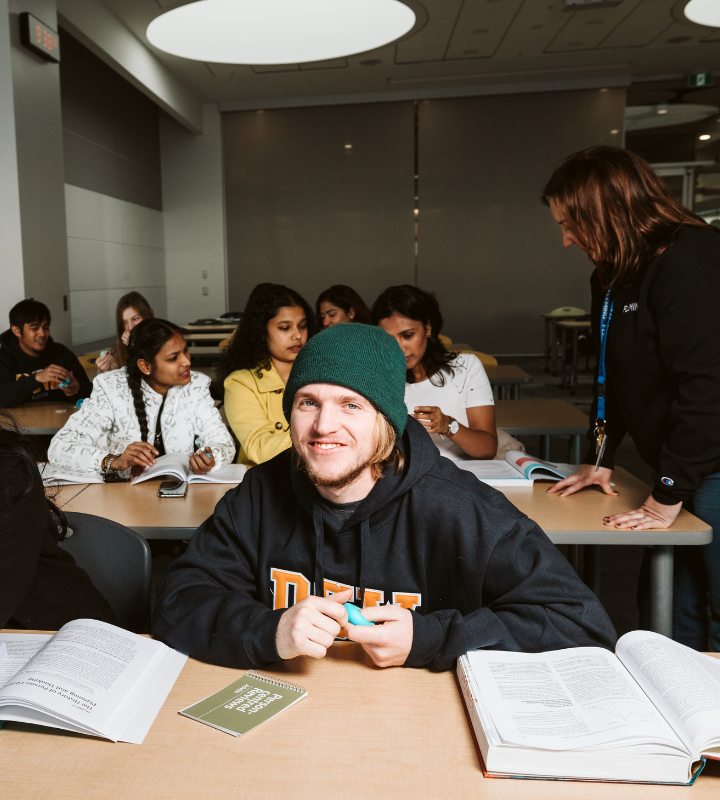
If you’re someone who finds meaning in helping others—and you're looking for a career that reflects that—working as a Developmental Service Worker (DSW) might be a path worth exploring.
At Fleming College, the DSW program is designed to prepare students to support individuals with a wide range of intellectual and developmental disabilities. But beyond the textbooks and classroom learning, it’s about building real relationships, creating inclusive communities, and helping people live full and independent lives.
What does a Developmental Service Worker actually do?
It’s a big question and the short answer is: a lot.
Graduates of the program go on to work with children, youth, and adults who have disabilities like autism, Down syndrome, Fetal Alcohol Spectrum Disorder, acquired brain injuries, or learning and physical disabilities. In this line of work, every day looks a little different. You might be:
- Supporting someone in a classroom
- Helping build life skills at home or in the community
- Facilitating person-directed planning (helping people set and work toward their goals)
- Supporting someone with employment or volunteering
- Working at a summer camp or in a recreation program
- Some even use individualized funding to start their own support businesses.
At its core, the work is about meeting people where they’re at, understanding their strengths, and helping them navigate systems and communities that aren’t always built with accessibility in mind.
What’s the program like at Fleming?
Fleming’s DSW program runs for two years and is offered in a hybrid format at the Sutherland Campus. That means you’ll have the flexibility of online learning with the benefit of in-person labs, simulations, and hands-on activities.
Courses cover topics like:
- Person-Centered Planning
- Fostering Inclusive Communities
- Counselling Interventions
- Case Management
- Intro to Psychology
In semester three, you’ll begin a field placement and by the time you graduate, you’ll have completed over 685 hours of hands-on experience in the field. That real-world exposure is a big part of why graduates leave feeling confident, connected, and ready to work.
Bonus perk: Students in this program often get to take part in fun, meaningful activities with the individuals they support—like cheering on the Blue Jays in Toronto or heading out on exciting day trips.
Why students choose this path
What draws people to this field isn’t flashy job titles or high-pressure competition, it’s a desire to make a real impact. Students often talk about how fulfilling it is to build trust with someone, advocate for their needs, or be part of small, everyday victories that mean everything to the person they’re supporting.
The program is grounded in values like dignity, empowerment, social justice, integrity, and the importance of healthy human relationships. If these ideas resonate with you, there’s a good chance you’ll find purpose in this kind of work.
What happens after graduation?
DSWs are in demand across Ontario—and there’s a wide range of settings where you can work. Some graduates stay local, while others take their skills across the country or even internationally.
You might find yourself supporting mental health initiatives, working in school boards, building community inclusion programs, or joining an organization that offers home- and community-based services. There’s even growing opportunity in self-employment, where you can offer one-on-one support through personalized funding models.
The work can be challenging, but it's also incredibly rewarding—and it allows you to make a meaningful impact every single day.
Is the Developmental Support Worker program a good fit for you?
If you're drawn to a career that combines compassion, advocacy, social justice, human rights, and action, the Developmental Service Worker program at Fleming College could be a great place to start. You don’t need to have all the answers now but if you’re curious, asking questions, or imagining yourself in this kind of role, it’s worth exploring further.
To learn more about the program, visit the DSW program page or connect with the admissions team. Your future career could start with one conversation and one choice to do something that matters.
Get the inside scoop on campus life, student experiences, and expert tips.
From hidden study spots to career advice, our blog is your go-to source for insights, inspiration, and everything in between. Have an inspiring journey, a unique campus experience, or a success story to share? Submit your blog idea to the Fleming Connect team for your chance to showcase your story to the entire Fleming community.